
KESTRIMD.COM
KestriMD
Clinical note clarity inside the care record
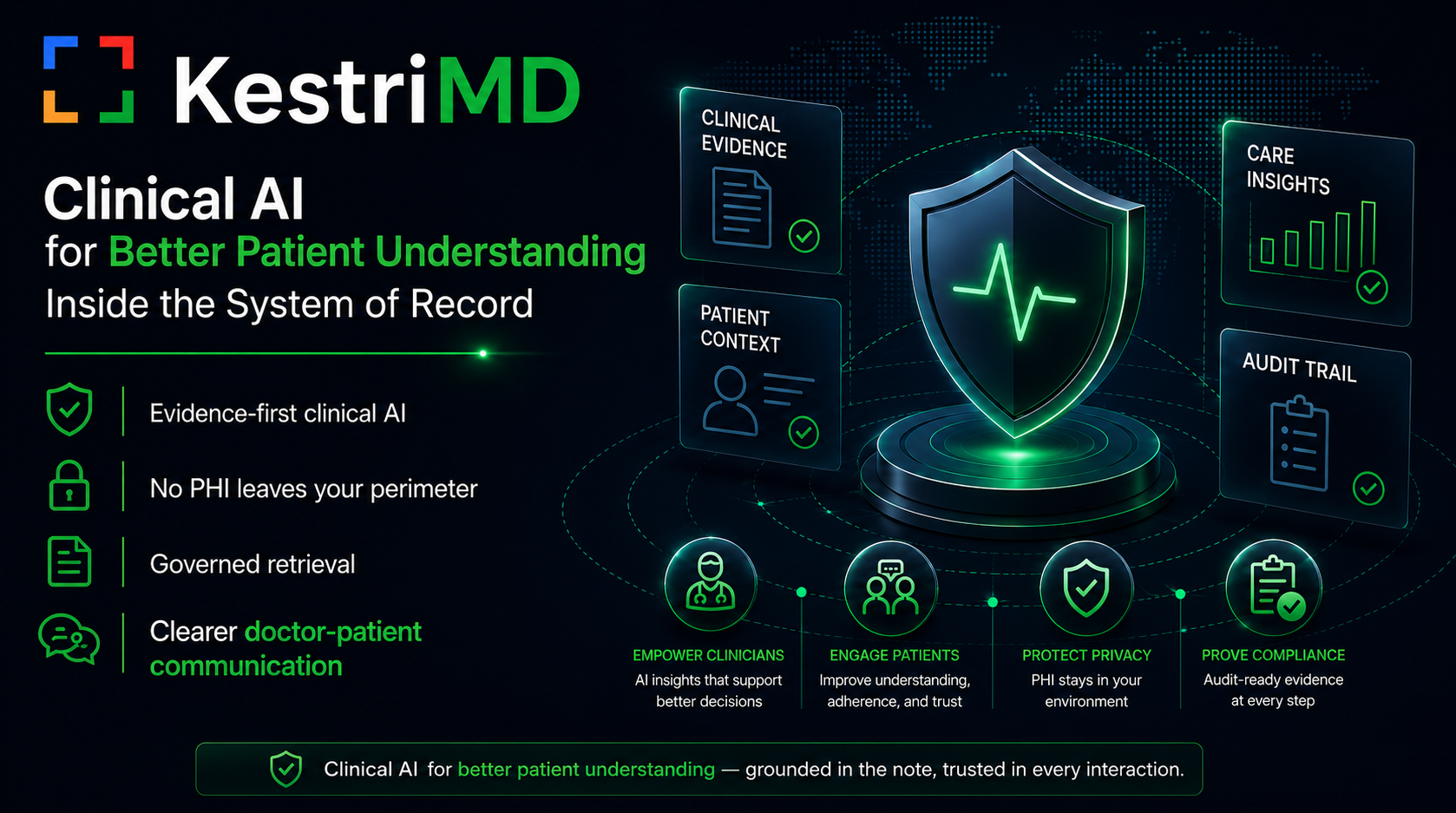
KestriMD helps patients understand what clinicians actually documented.
Clinical notes are the source of truth. KestriMD explains what the note says, links clarity back to the original sentence, and preserves the medical record.
No rewriting
No guessing
Source anchored
Patient clarity
HOW IT WORKS
Clinical note → Patient question ← Original note evidence
KestriMD grounds patient-facing explanations in the provider’s original documentation.
Traditional patient AI
Note → Model → Simplified story. Meaning can shift.
KestriMD
Patient question → Governing sentence → Understanding. The note stays intact.
LIVE DEMO — CLINICAL NOTE CLARITY
Highlighted phrases remain grounded in the original clinical note, improving patient understanding while reducing clinician follow-up questions, inbox traffic, and back-and-forth communication.
Colors =
deterministic structure • blue: structural anchors • green: contextual support • pink: strongest
probabilistic signal
Dear Mr. Smith,
The May thyroid tests showed TSH 2.22 794 U ml, which, though normal, is too high for someone who has had prior thyroid carcinoma. Keeping TSH between 0.22 1 0.3 U55/ml minimizes recurrence of thyroid cancer. Free T4 1.77 60 mg% is a high-normal level.
I suggest you increase L-thyroxine from 150 mcg 7 days a week to 150 mcg 5 days a week and 225 mcg (11166/22 tablets) Wednesdays and Sundays weekly. Have a repeat TSH , free T4 and total T3 in 8 weeks. I should also on that occasion like you to have a serum plasma metanephrine level. Two weeks after having those tests , please see me for a consultative office visit.
Sincerely yours,
John Sung, M.D.
Endocrinology.
The May thyroid tests showed TSH 2.22 794 U ml, which, though normal, is too high for someone who has had prior thyroid carcinoma. Keeping TSH between 0.22 1 0.3 U55/ml minimizes recurrence of thyroid cancer. Free T4 1.77 60 mg% is a high-normal level.
I suggest you increase L-thyroxine from 150 mcg 7 days a week to 150 mcg 5 days a week and 225 mcg (11166/22 tablets) Wednesdays and Sundays weekly. Have a repeat TSH , free T4 and total T3 in 8 weeks. I should also on that occasion like you to have a serum plasma metanephrine level. Two weeks after having those tests , please see me for a consultative office visit.
Sincerely yours,
John Sung, M.D.
Endocrinology.
∎
Kestri: Audit-ready answers—regulator-ready in real time.
CLINICIAN-GOVERNED CLARITY
Highlight everything. Activate only what the clinician approves.
KestriMD can highlight the clinical note by default, while the clinician chooses
which sentences activate dual-embedding clarity before the note is handed to the patient.
Patients can point-and-click only where the clinician has enabled explanation.
Clinician controls the interactive record
Sentence selection stays governed by clinical judgment, not open-ended patient AI.
Not a healthcare recommendation engine
KestriMD does not replace clinician judgment, recommend treatment, or rewrite the medical record.
It explains clinician-approved sentences back to the original source.
Clinical note → Clinician approval → Patient clarity
The clinician governs what becomes clickable. KestriMD preserves the evidence path.
Colors =
deterministic structure • blue: structural anchors • green: contextual support • pink: strongest
probabilistic signal
Dear Mr. Smith,
The May thyroid tests showed TSH 2.22 794 U ml, which, though normal, is too high for someone who has had prior thyroid carcinoma. 1⇗ 1⇗ Keeping TSH between 0.22 1 0.3 U55/ml minimizes recurrence of thyroid cancer. 4⇗ 4⇗ Free T4 1.77 60 mg% is a high-normal level.
I suggest you increase L-thyroxine from 150 mcg 7 days a week to 150 mcg 5 days a week and 225 mcg (11166/22 tablets) Wednesdays and Sundays weekly. 6⇗ 6⇗ Have a repeat TSH , free T4 and total T3 in 8 weeks. 7⇗ 7⇗ I should also on that occasion like you to have a serum plasma metanephrine level. Two weeks after having those tests , please see me for a consultative office visit.
Sincerely yours,
John Sung, M.D.
Endocrinology.
The May thyroid tests showed TSH 2.22 794 U ml, which, though normal, is too high for someone who has had prior thyroid carcinoma. 1⇗ 1⇗ Keeping TSH between 0.22 1 0.3 U55/ml minimizes recurrence of thyroid cancer. 4⇗ 4⇗ Free T4 1.77 60 mg% is a high-normal level.
I suggest you increase L-thyroxine from 150 mcg 7 days a week to 150 mcg 5 days a week and 225 mcg (11166/22 tablets) Wednesdays and Sundays weekly. 6⇗ 6⇗ Have a repeat TSH , free T4 and total T3 in 8 weeks. 7⇗ 7⇗ I should also on that occasion like you to have a serum plasma metanephrine level. Two weeks after having those tests , please see me for a consultative office visit.
Sincerely yours,
John Sung, M.D.
Endocrinology.
∎
Kestri: Audit-ready answers—regulator-ready in real time.
WHY IT MATTERS
Evidence-linked by default
Every explanation points back to the original note.
Clinician-governed by design
KestriMD can highlight the clinical note by default, while the clinician selects which sentences activate dual-embedding clarity before the note is shared with the patient.
Highlight everything. Activate only what is approved.
Patients can point-and-click only where the clinician has enabled explanation.
This preserves clinical control and prevents open-ended patient AI.
Not a healthcare recommendation engine
KestriMD does not recommend treatment, replace clinician judgment, or rewrite the record.
It explains clinician-approved sentences back to the original source.
Works with existing systems
No rip-and-replace. No EHR migration required.
AI should help patients understand clinical language — not replace clinician judgment.
Because once AI inserts itself deeply into live clinical decision paths, the chance of operational failure becomes very real very fast.
Medicine is still human judgment under uncertainty.